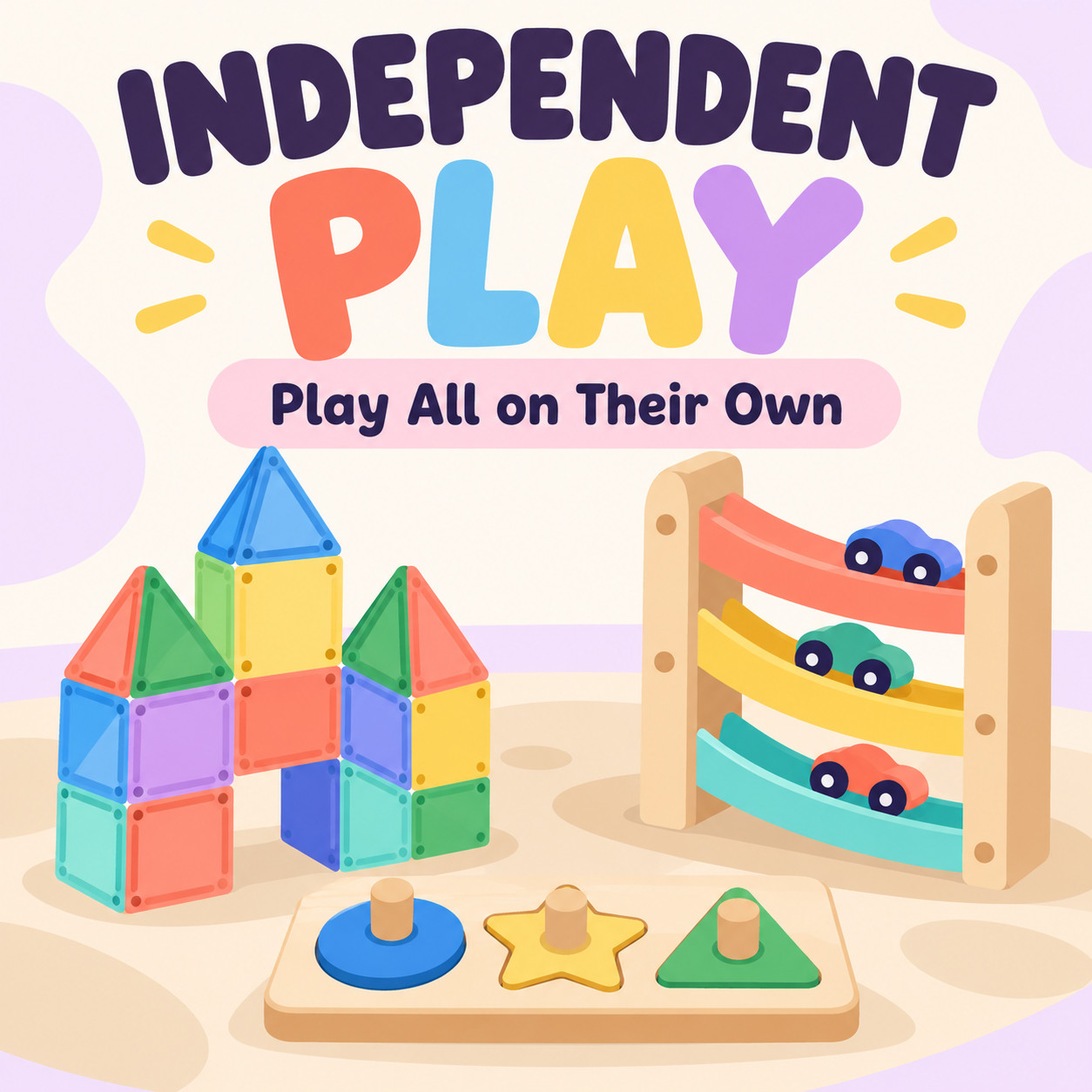
Independent play means your child plays on their own while you’re nearby. Most kids can learn to play independently by age 2; however, you can start practicing in small 5-10 minute chunks even when they are babies.
Note: By independent play I do not mean unsupervised play. I mean playtime for your child on the floor, while you sip a coffee in the same room.
This post may contain affiliate links. As an Amazon Associate I earn from qualifying purchases at no extra cost to you. Every click helps keep this site running. Thank you🪀
Maybe you have a shadow, a velcro-baby, or a mini-me who follows you around no matter where you go.
And as much as you love your child, sometimes it would be nice to just go to the bathroom by yourself, or put on a load of laundry without 100 questions.
Getting your child to play independently is not only a benefit to you (hello cup of morning coffee ☕) but also a benefit to the child.
They can learn problem-solving skills, as well as learn to tolerate being separated from you for short periods of time, and independent play is what makes quiet time possible as they drop naptime. These are all important milestones as they get to school age.
Want the Toy Rotation Guide?
A free 2-page system for cutting the mess & maximizing playtime sent straight to your inbox.
I have two kids in the 0 to 6 range. I was a classroom teacher for over a decade. I’ve seen a wide range of children: from the “I can do it, I don’t need any help,” to the “I can’t find my pencil!” –spoiler alert: it was in their hand.
The secret is much like learning to talk, sit, and walk; independent play is a skill that needs to be taught and nurtured.🧸
What is Independent Play?
Independent play is a child entertaining themselves without you directing, narrating, or problem-solving for them.
Independent play is not:
❌ Ignoring them
❌ A punishment
Think of independent play as a scale. There may be, at one end of the spectrum, the child who has trouble playing even for 5 minutes by themselves, and on the other end of the spectrum a child who is so content to play alone it’s difficult for them to socialize and play with others.
My goal is always balance and moderation. Maybe we can get that 5-minute child to 30, 40, or even 60 minutes of independent play over time.
And maybe the child who always wants to play by themselves might come around to playing tag on the playground over time.
⚠️ It’s not all or nothing: The biggest thing I hear from parents (and I think it’s also the biggest misconception) is that, “my child can’t play by themselves,” and that’s it. Rarely can an otherwise healthy child not be able to play independently. It’s just a skill that needs to be taught, and then practiced. Just like walking, swimming, and riding a bike.
We Are Social Creatures
Humans are meant to be social. We are meant to live with other people, spend time with other people, communicate with other people. We are not wired to be by ourselves… Which is probably why I still have a hard time going to eat lunch out by myself.
Not only that, children have other considerations that make playing a challenge independently:
- Age: Independently playing for an infant might look like them watching you from a high chair or playpen while you make dinner. They aren’t really “playing” by themselves yet. More just observing quietly from a distance.
- Unwilling, not unable: If you’ve never asked your child to play independently, you shouldn’t expect them to know how to do it without teaching them.
- Separation anxiety: This might look more like a complete meltdown when you ask them to go get their shoes from one room while you stay in another. It might also look like them clinging to you for dear life when you try to put them in their room for nap or quiet time.
Separation anxiety is hard for children (and parents) to overcome. Many tears were shed from this mama dropping her unwilling toddler at daycare 😭. But for independent play, there is hope! They can come with you, but instead of insisting on folding laundry or unloading dishes, they can play with their toy quietly in the kitchen beside you.
You Might Also Like

How to Teach Your Kid to be Independent
I encourage you not to sit your child down with a pile of blocks, tell them they are going to play while you make dinner, and walk away.
Teaching independent play actually happens through natural moments in the day that you can eventually build on once your child is comfortable with:
☑️ Being apart from you for a few minutes
☑️ Being bored for a few minutes
You have to teach independent play the same way you teach anything else. Here are some examples of teaching those two building blocks to your child:
- A short car ride: with no music, tablets, talking, or toys. Just watch out the window, and listen to the sounds.
- An errand: where they just sit or stand and observe what you’re doing.
- A chore: “You can come with me while I unload the dishwasher, but today mommy is going to do it herself. You can watch.”
Soon your little one will be “watching raindrops race each other” on the car window, imagining “princesses and fairy godmothers” while you’re brushing your hair, and decide to run off and play on their own instead of watching to unload the dishwasher again.
How to Teach Your Kid to Play Independently
Here is how to encourage independent play. Once your little one is comfortable being bored out and about, and sufficiently over how many times a day the dishwasher needs to be unloaded (why are there so many dishes!? ), you’ll notice them start to naturally separate from you into independent play mode.
This might look like:
- Talking about imaginary stories to themselves while in a shopping cart or car seat
- “Playing” with no toys, just their bodies and imaginations while you run the house
- Or, if you’re a lucky one, they may choose to just go find their toys and :gasp: play by themselves. Note: This is rare.
But once they have separated into their imaginary world, they are ready for that quiet playtime!
And now is your chance to read your book, make that phone call, scroll your phone, or whatever else you’ve been wanting to do!
Here’s how to make it happen:
- Set a timeline: “After lunch, mommy needs to go fold the towels, but I’ll get some toys out for you to play with while I do that.”
- Give a reminder: “We’re almost done with lunch; remember, Mommy is going to fold towels while you play.”
- Follow through with guidance: “Mommy is going to go fold the towels; you are going to stay here for 5 minutes and play with your X, Y, Z. If you need me, come and find me.”
- Don’t be discouraged: The first few times you do this will likely be as pleasant as the first few “silent car rides” 😬. They will come find you. But keep your cool and redirect them. “Mommy is still folding towels; did you want to go play with X, Y, Z, or do you want to bring them here and play beside me?” Over time, they will stop coming. I promise.
- Extend the time frame: Independent play for toddlers looks like 10 to 15 minutes at first. Once you’ve mastered a 5-minute task, set your sights on 10, 15, 20, or even an hour! The sky is your limit. My kids routinely play independently during quiet time for about 2 hours and 45 minutes every day.
- Accept setbacks: They watched a scary movie. Their friend told them something upsetting. They are sick and not feeling well. Any number of things might come up to set you back on your independent play. Just keep your cool, and you can always go back to the building blocks like quiet car rides, errands, and chores for a day or two until they remember, “Hey, it’s more fun to go play!”
🛍️ Shop My Amazon Storefront
Every toy, book, and must-have from the site organized and ready to shop in one place.
As an Amazon Associate I earn from qualifying purchases at no cost to you.
Having the Right Toys for Independent Play
I am a huge believer in toy rotation. It keeps the toys tidy-ish for parents, and makes all of the toys feel brand new for the kids each time it happens.
Brand new toys= a lot more attention span for independent play!
Another recipe for more independent play? A wide variety of types of toys. I’ve identified 11 major toy categories, and keeping a big mix of toys available will lead to significantly more independent playtime.💜
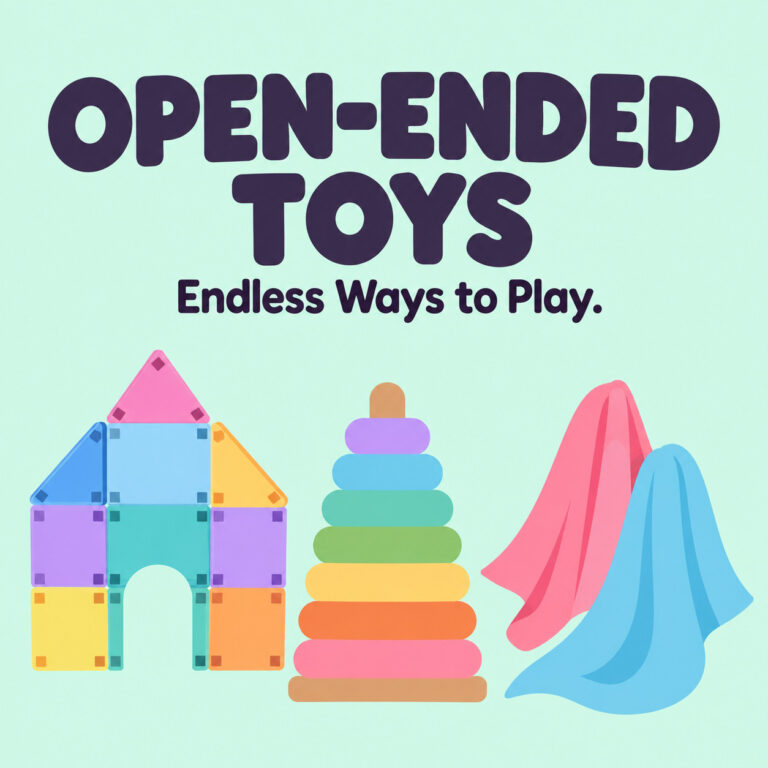
Open-ended toys hold attention the longest, so start there. For babies, see my best toys for 1-year-olds. For preschoolers, see the best toys for 3-year-olds.
🚨 Independent play is not unsupervised play! Do not leave your child ages 0-6 unsupervised during play. If you’re going in another room, make sure you have a camera or monitor where you can keep eyes on them at all times. For families with open floor plans, it’s easier to do laundry or make dinner while keeping an eye on the living room. Otherwise, install some cameras so that you have eyes on your child at all times while you move through the house.
Face Time: The Key to Success
If we’re asking our kids to play independently, we need to offer them uninterrupted face time with us at some point during the day as well. After all, we are their whole world.
Parents should dedicate at least 15 minutes a day per child to do whatever their hearts desire. Play make-believe, do a craft, paint each other’s nails. Whatever!
It just needs to be 15 uninterrupted minutes. No, “let me check my email real quick,” “oh, I forgot to send that picture to Nana, let me do that now,” or any other interruptions from our phones, work, friends, or family.
Everything I Recommend, In One Spot
I keep every toy from my site organized in one shoppable Amazon list.
As an Amazon Associate I earn from qualifying purchases.
You Might Also Like
Ready to Take Your Toy Rotation to the Next Level?
A simple two-page system for cutting the mess and making playtime more fun & last longer!
Get StartedFrequently Asked Questions
At birth! Start those independent tasks early: quiet car rides, having them watch you do chores or get ready. When they get a little older they can crawl around a playpen and entertain themselves.
Not necessarily. Are they unwilling because they don’t know how? Are they anxious about being alone? I would take a few different approaches to it with some time in between each. If nothing changes or things seem to be getting worse, give your pediatrician a call. They likely have other ideas to help you.
Independent play is the skill. Can they play by themselves without you?
quiet time is a framework where children replace their daily nap with a block of independent play that is restful and restorative to both the child and the parent: hence the name quiet time.
Not necessarily. It can happen right next to you, as long as you are not the one directing it. A kid playing quietly on the floor while you fold laundry a few feet away is independent play, even though you are in the same room. If you can’t monitor your child while they play, you must stay in the same room. This doesn’t mean that they can’t be playing while you do something else.
Screen time is screen time. Whether they are quiet for 10 minutes or 2 hours, that was not independent play, that was screen time. Don’t get me wrong, we have daily screentime in my house for 20-40 minutes two times a day (once for morning chores while they have snack, and once to prep dinner while they have snack). I am not anti-screen, I am just stating that any time they are on a screen does not count as independent play because they are not entertaining themselves.
Aiming for 2-3 minutes a few times a day is a good place to start. Going to the bathroom, pouring your coffee, opening the mail. It makes me think of naps for infants. First they are napping every hour for 30 minutes, and soon it starts to consolidate to bigger chunks of time.
23 thoughts on “How to Get Your Kid to Play Independently”
Comments are closed.