My oldest used to talk himself to sleep, not to me, but to a stuffed animal and whatever book was in his crib that night, narrating his whole day out loud until he wound himself down.
We never taught him that. We just noticed it, left him to it, and realized we had accidentally found the first version of what became a quiet-time routine in our house.
This post may contain affiliate links. As an Amazon Associate I earn from qualifying purchases at no extra cost to you. Every click helps keep this site running. Thank you🪀
As a busy mom of two boys, I was dreading the day that my beloved nap time would come to an end. It was the peaceful 2-hour block in my day that was just for me.
Naptime started to become more difficult, but I knew I just wasn’t ready to give up that chunk of time (and neither was my toddler!). So, through a lot of trial an error our quiet time routine was born. 🧸
Want the Toy Rotation Guide?
A free 2-page system for cutting the mess & maximizing playtime sent straight to your inbox.
What Is Toddler Quiet Time?
Quiet time is generally what replaces nap time once a child is ready to drop their nap, but is not yet school-age. Quiet time only works once your child has some independent play skills.
It’s easy to frame it as just a break for the parents (because honestly, that was the entire reason I started it!).
But, in practice, quiet time has shown me that it offers more benefits than just a break from each other:
- A predictable time block to practice independent play
- Starting some separation from the parent (for those who struggle with separation anxiety)
- A time to experiment and solve problems on their own
- A time to be creative without input or judgement from anyone else
- A slow, boring, quiet time to reset and unwind from our busy schedules
- Learning to tolerate boredom
The Six Key Ingredients for a Successful Quiet Time
A successful quiet time is not really about the toys, even though that is usually the first thing people ask me about. Toddler quiet time works when these six things are in place:
- A schedule — consistent, even if it is not the same clock time every single day.
- Clear expectations — what is and is not okay during that block.
- Consistency — holding the boundary the same way, day after day.
- A dedicated space — in a separate room, across the hall, etc.
- A way to monitor them — you are still supervising (either in the same room or with a monitor), even for an independent 6-year-old.
- A communication method — both what they are allowed to ask for, and how.
Toys do matter; at the end of the day, they need something to keep them busy during that quiet time window.
But if you don’t have these six ingredients, your quiet time is going to be more hectic (read: more tantrums) and less successful.
The Light At the End of the Naptime Tunnel
I know I’m not alone in feeling the dread when you feel naptime coming to a close.
What am I going to do with my kid all day? When am I going to get a shower? They are already so cranky at bedtime; is it going to be a struggle all afternoon?
Know that switching to quiet time once naptime starts to become a struggle is the answer to all of those questions.
My kids have done quiet time since they were about 3.5ish. They do 2 hours after lunch, and 45 minutes to an hour at bedtime.
Yup, you heard it here, folks. My kids get at least 2.75 hours of playtime in a room, without me, leaving me free to do whatever I want.
Every. Single. Day.
Some might find this is too much, and that’s totally fine. The goal isn’t to get all kids into the same routine.
The goal is just to get into some kind of routine that works for both the parents and the child. Whether that’s 1 hour of quiet time or more.
You Might Also Like
What Goes In the Quiet Time Space
Try to set up the space to meet all of their needs so they don’t need to ask or interrupt you.
This can look like toys, a pillow and blanket (if they want a nap), their comfort items (stuffies, etc.), a bottle of water, tissues, etc.
In addition, here are a few of the things I specifically use to make quiet time easier for everyone.
1. Baby Monitor
My kids have quiet time in a separate room from me upstairs. Quiet time is absolutely not unsupervised time.
I watch my baby monitor like a hawk and emphasize how crucial it is that you are monitoring your child for their safety.
We mounted this in the top corner of the room so it can pan, zoom, and tilt to see the entire play area.
I also like that it came with two cameras (so eventually we put a second one in the younger child’s space), and that I can watch from my phone (because I always forget the parent unit beside my bed.





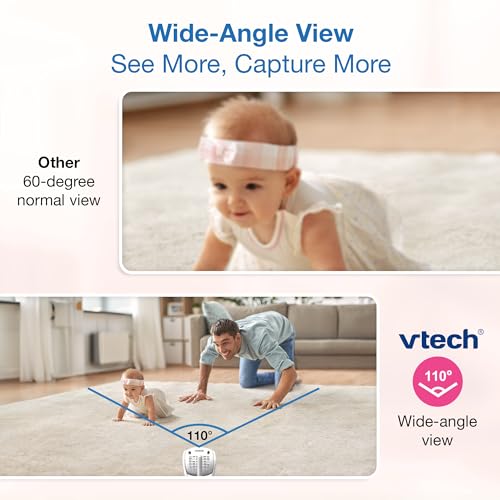


VTech Smart WiFI Baby Monitor VM901-2
I love that I can watch two kids at once all on one parent device. I can also tilt, pan, and zoom to see all around the room, and use the 2-way talk to communicate with my kids when needed.
2. Walkie-Talkies
Although our baby monitor (above) does have 2-way talk, it was inevitable that my older son would say something to me while the camera panned to my younger son’s room. Or, he would speak so softly I wouldn’t hear him.
We landed on walkie-talkies so that he has to be deliberate when talking to me. And there is also a “phone ring” button to get my attention if, for some reason, I don’t hear him.
Yes, these are intense walkie-talkies for kids. But they can be set and locked by the parent so they can’t change channels.


FOREDOM Walkie Talkies for Kids
We use walkie-talkies to communicate during quiet time. These are easy for parents to set up, and easy for kids to use.
- 2-MILE RANGE & 22 CHANNELS: Ensure clear communication up to 2 miles in open areas with 22 interference-free channels for uninterrupted outdoor adventures.
- HANDS-FREE VOX FUNCTION: Kids can talk naturally without pressing buttons, fostering teamwork and immersive role-play experiences.
- KID-SAFE DESIGN: Durable, impact-resistant material with adjustable lanyards and keypad lock to prevent accidental setting changes.
3. VTech Soother
Any ok to wake clock with a color setting works for this. This light (which doubles as a nightlight) lets me set very specific timed color routines. We set it to red for quiet time, yellow when quiet time is almost over, and green when it’s time to come downstairs.
What I love most is that there is a manual override for when 💩 hits the fan (it happens even to the most seasoned quiet-timers) and I need to pull the plug on quiet time, without them thinking that they have won!
I can manually set the light to yellow, and then to green, without them knowing there was any interference at all.


VTech V-Hush Soothing Sleep Trainer
We use this to set up our quiet time timer (light red= quiet time or sleep time/light green= play time or awake time).
- 200+ Preloaded Stories, Lullabies, Songs & Sounds: Choose from 100 stories, 100 classical songs, 10 lullabies, and 10 natural sounds to create the bedtime routine. Record and play your own voice for extra comfort – helps babies and toddlers drift off peacefully
- Mesmerizing Glow-on-Ceiling Projector + Multi-Color Night Light: Project gentle, calming images on the ceiling with 6 different frames and enjoy over 250 color options for the soft night light. Creates a magical, soothing sleep environment without harsh lighting
- Powerful 360 Bluetooth HD Speaker: Stream your favorite music or use the built-in content with rich, clear sound that fills the room. Suitable for bedtime playlists or custom recordings from parents and grandparents
- Expert Sleep Program with Temperature Monitoring: Follow a guided program designed by sleep experts with tips, timers, and real-time room temperature display. Helps establish healthy sleep habits while keeping parents informed about nursery conditions
4. Yoto Player
We use Yoto players for audiobooks during quiet time. Tonies work too. I compare the screen-free audio players in my musical toys guide.
I love that the Yoto has a free daily podcast that my little ones love to listen to, as well as the ability to listen to:
- books
- movies
- podcasts
- kid-appropriate music
- live kid radio
- listen and draw activities
- listen and move activities
- trivia
- and more


Yoto Mini
I could go on and on about how much we love Yoto players at my house, and I do in my full Yoto review! These are a part of our daily routine, and come with us wherever we go.
- SMALL SPEAKER FOR BIG ADVENTURES: Yoto Mini lets kids explore their imaginations as they explore the world. Fill road trips, car rides, flights, long journeys & play dates with inspiring audio!
- EASY TO SET UP & USE: Children from 3-12+ use physical cards to explore the best audio content on the move. Simply pop an audio card into the Mini to play & remove to stop. Adjust volume or tracks with the dials. Alternatively, control the Mini via the free app!
- KID-FRIENDLY WITH PARENTAL CONTROL: Enjoy up to 14 hours of safe & screen-free entertainment per charge. No cameras. No mics. No ads.
- MULTI-PURPOSE: Features a pixel display to bring the audio to life, play sleep sounds, use as bedtime storyteller, an OK-to-wake clock, a portable audio speaker or use with headphones!
- CONTENT THAT GROWS WITH KIDS' MINDS: Explore 1000+ cards of bestselling audiobooks, music, educational activities, free podcasts, radio, soundscapes, timers or even create content with a Make Your Own card!
When It Doesn’t Go Smoothly
If you think quiet time is a smooth and perfect process in my house (afterall I did boast about 2.75 hours a day of quiet time), think again.
Quiet time can often (the days surrounding when I’m writing this article) sound like a WWE wrestling match between my kids.
Kids asking to come downstairs, and me agreeing (even though I know better) because it’s “just easier,” and I can get back to my work quicker.
Sometimes quiet time sounds like I’m absolutely losing my mind at what a terrible job my kids are doing at following the quiet time rules.
Others, it can sound loud and hectic because we forgot to charge the walkie-talkies and now we’re shouting from one floor to the next.
All this to say, our quiet time routine is my saving grace during the day, and I think it has been so tremendously helpful for my children’s development and independence.
Yet, even those of us who literally wrote the book on quiet time sometimes have bad days. And that’s ok.
Everything I Recommend, In One Spot
I keep every toy from my site organized in one shoppable Amazon list.
As an Amazon Associate I earn from qualifying purchases.
Quiet time is one piece of a bigger system at my house. This also includes toy rotation and independent play.
Toy rotation can be a great way to keep quiet time feeling fresh. If you want to get started with toy rotation, sign up for the starter guide below💜
You Might Also Like


Ready to Take Your Toy Rotation to the Next Level?
A simple two-page system for cutting the mess and making playtime more fun & last longer!
Get StartedFrequently Asked Questions
Right around when a kid is starting to show signs of dropping their nap, which varies a lot but often lands somewhere between 2 and 4. It can also start later, whenever the natural nap-to-quiet-time transition happens in your house.
Anywhere from 30 minutes to 2 hours tends to work, depending on the kid and your own schedule. Longer is not automatically better. I would rather a family have a solid 30 minutes that actually holds than an ambitious 2 hours that turns into a daily fight.
It is the successor to nap time, not a replacement in the sense of forcing sleep. A kid can nap during quiet time if they get tired, or stay awake and play quietly the whole time. The structure stays the same either way.
This is common enough that I have a three-tier approach to this:
- Walk yourself to your quiet time space, or I will take you there for you
- If you can’t stay with the door open (priviledge), I am going to close it
- These are the quiet time rules. If you break the rules there will be consequences. The first consequence will be losing your X, Y, Z for 10 minutes. The next consequence will be [insert consequence here].
Some way to supervise, yes, even for an older, generally trusted kid. That can be a baby monitor, a repurposed one you already own, or being in the same room, depending on your setup. You can also use a wifi camera that you can monitor on your phone.
Let’s put it this way, I once was watching my oldest on the monitor, yet didn’t notice that he had been using the charging cable to his Yoto player as an “anchor for his ship,” and the cable was completely severed by the end of quiet time. Luckily for everyone, the cord wasn’t plugged in, but even the best-meaning children can find hazards in spaces we think are safe.
Open-ended toys and screen-free audio tend to hold up best without a parent in the room to help. Closed-ended toys, puzzles, and instruction-following sets especially are better saved for times you are actually available if your kid gets stuck.
My two kids are so different. One wants an entire Michaels store in his room to do arts and crafts. The other wants the full suite of Melissa & Doug costumes to play dress-up and make-believe.
Pay attention to those toys that your kids seem to gravitate to. The ones they play with by themselves. And then capitalize on those.
22 thoughts on “Quiet Time for Toddlers: How to Set Up a Routine”