I have two kids, 4 and 6. I think I’ve probably bought them 20 toys between birthdays, Christmas, and other occasions (like travel or a milestone).
But, I’d hazard we’ve accumulated at least 10 times that from friends, grandparents, aunts, uncles, McDonald’s (thank you, Happy Meals).
This post may contain affiliate links. As an Amazon Associate I earn from qualifying purchases at no extra cost to you. Every click helps keep this site running. Thank you🪀
At a certain point it just gets sooooo hard to stay on top of the mess of all of those toys… Not to mention the mental frustration when your play space is bursting at the seams, and your child comes to tell you they’re “bored,” and “there’s nothing to play with.”
Enter toy rotation. It boils down to:
- Keep most toys out of sight
- Pull out a few to play with
- Relish your kids feeling like it’s Christmas every time you do it
If you want more details on what toy rotation looks like at my house, and what I recommend to parents starting out, download my free toy rotation guide.
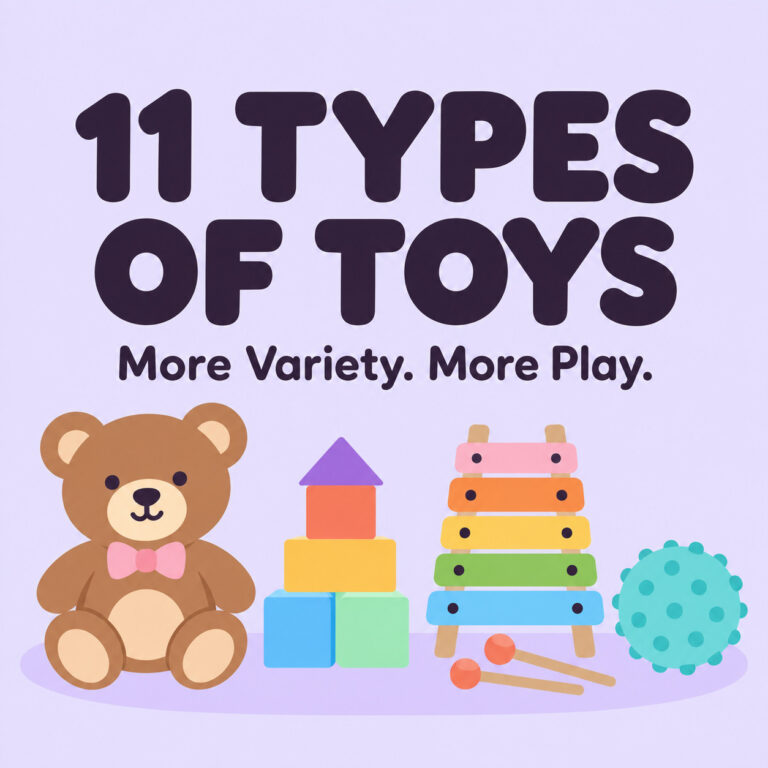
I break down every category, with examples at each age, in my 11 types of toys guide.
Want the Toy Rotation Guide?
A free 2-page system for cutting the mess & maximizing playtime sent straight to your inbox.
The Two-Shelf System
This is critical. You have to have a place (shelf, toybox, garage, basement) where the majority of the toys can live.
The second shelf (or toybox, etc.) is where the current toys are stored in the play area.
The Golden Rule of Toy Rotation
Toy rotation is the backbone of our quiet time routine. Here’s a little secret: it does not matter how often you rotate, how many toys you pull, or how and where you store and display your toys if you don’t follow this one rule:
- You are in control of the toy rotation. Not your child.
The moment the kids influence which toys you pick, or when, you’ve lost ground that you’re not easily going to get back.
How Many Toys, How Often
Here is how to rotate toys: sort by category, pick one from each, store the rest out of sight, and swap every week.
This depends on age and how often you are rotating, but roughly it’s an 8-toy max. Staying consistent is also key.
If you rotate every week on Sunday, make sure it happens. The kids are looking forward to it.
If you usually bring out 8 toys and this week you only grabbed 5, be prepared for some questions about the whereabouts of the others.
The 11 Play Categories
Toy rotations usually fail because they are hard for the parents. Packing up the old toys, putting them away, picking new toys, all in hopes that your kids will play with them… And then they find you 10 minutes later to express their dissatisfaction.
My toy rotation system focuses on introducing toys from 11 major play categories to keep play alive. If you need toy rotation ideas, start with one toy from each category.
- Gross Motor Toys for small spacse and big energy
- Fine Motor Skills Toys to master small movements
- Best Open-Ended for unlimited play
- Close-ended toys are puzzles and games with one right answer
- Blocks and building toys go in every rotation
- Musical and multimedia toys include screen-free audio players
- Art Supplies for kids’ creativity
- Sensory toys cover sand, dough and bins
- Pretend Play for acting, pretending, and learning about life
- Nurturing Toys to foster empathetic little beings
- STEM toys are the newest category on our shelf
You Might Also Like
Blocks Everywhere!
A gear kit, Magna Tiles, Lego, Duplo, K’nex, and snap-together flowers all have one thing in common: they’re all blocks!
If you pulled all of those toys for a rotation, sure your child would be happy at first (children love blocks!)… But the novelty would wear off (fast!) because at the end of the day, they are all blocks.
Be mindful when choosing your toys that you’re picking from each of the categories and not leaning heavily on one or the other.
Want more tips on toy selection? My free 2-page guide goes over how to ensure you’re pulling from different categories for a successful toy rotation.
Keep It Fresh
You might have done the math… I suggest no more than 8 toys, but I also suggest pulling toys from each of my 11 play categories… The math doesn’t math!
Usually toys overlap. A doctor set can double as pretend play and nurturing (taking care of patients). So you’ve knocked off two categories with one.
It doesn’t have to be that deep. If you don’t hit all categories for one rotation, keep that in mind as you’re putting toys away (“hm, I didn’t put out any musical or art toys last week”) and make sure that those are the toys you pull first for the next rotation.
🛍️ Shop My Amazon Storefront
Every toy, book, and must-have from the site organized and ready to shop in one place.
As an Amazon Associate I earn from qualifying purchases at no cost to you.
Taking It Outside
Toy rotation as I have described it is built for indoor play, quiet time, family time, the hours you are actually in the house. But the same principle works outside if that is where your family spends most of its time.
Same structure: some toys put away in a shed or garage, a small area where current toys live, and picks pulled from categories, just translated outdoors.
- Art becomes sidewalk chalk
- Sensory becomes bubbles or a water table
- Gross motor is whatever your yard allows, a trampoline, a balance beam, a hose
- Role play might be a mud kitchen instead of an indoor one
Why This Works
A good rotation is the easiest way to build independent play. This is close to a Montessori toy rotation, but with more open-ended and pretend play mixed in.
Kids get overwhelmed by choice exactly the way we do. They also get overstimulated from mess and toys scattered everywhere, as we do.
They are looking at a giant pile of toys, and all they see is a literal pile of toys. They don’t see that their favorite Bluey is in that pile.
They may have a Thomas the Train, but then not be able to find the tracks to play with it because they are lost in the pile.
This isn’t to say that I’m assuming that everyone’s toys are a mess… I know plenty of families where every toy has a bin and a home, and things stay right where they are supposed to.
Generally, the same thing happens though: they are looking at a big wall of toys and unable to see or remember what’s actually in there.
By limiting what they can see at once, they know which toys are available to them. And it feels like Christmas every time you do it 🎁.
Everything I Recommend, In One Spot
I keep every toy from my site organized in one shoppable Amazon list.
As an Amazon Associate I earn from qualifying purchases.
You Might Also Like
Ready to Take Your Toy Rotation to the Next Level?
A simple two-page system for cutting the mess and making playtime more fun & last longer!
Get StartedFrequently Asked Questions
No more than 8.
There is no universally correct answer (as long as you’re following the golden rule!). But once a week is a solid starting point.
Ideally yes. But remember most toys cover 2-3 categories at once. Do your best. If you miss a certain category one week, just make sure to bring it out the following week.
Anywhere your child cannot access without you.
Gah. This is where you lose all control. I’m 6 years in at my house and ask me if I’ve lost control? You bet. It’s tough. They become attached and will play quietly for 30 minutes with their favorite toy and it’s just so much easier to say yes than no. My guide has some ideas on how to tackle this so it doesn’t become a power struggle.
Yes. Pull separately by age if their interests do not overlap much, or pull a shared set if they play together well. A lot of categories, blocks and role play especially, work across a wide age range on the same shelf.
16 thoughts on “Toy Rotation: A Guide to Less Mess & More Play”